



Published
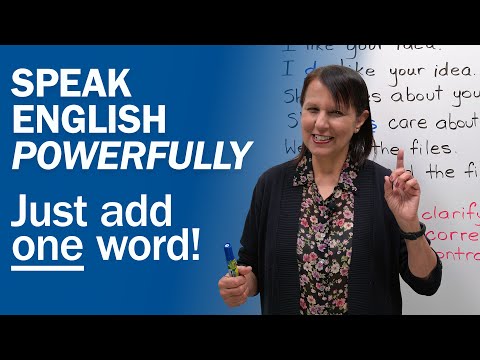
By adding just ONE word to your English sentences, you can sound more fluent, natural, and confident. Learn how to add *“do”, “does”,* or *“did”* to your sentences in this lesson. We’ll practice using these magic words in professional, academic, and social contexts. You’ll see how one small change can help you connect more effectively and sincerely with others in English – today and always! https://www.engvid.com/speak-english-powerfully-just-add-one-word/
Watch the first video in this series: https://youtu.be/vbJJql7dbrw
In this lesson:
0:00 Add ONE WORD to speak more powerfully
4:49 Full Examples
7:27 Practice with me
Transcript:
Hi, and welcome to our series on Speaking English Powerfully. Today, you'll learn how adding just one word can change how you sound instantly. You'll see how this one word can make you sound more fluid, more natural, and more confident in English. Alright? Are you ready to learn what those words are? One word at a time, here we go. Okay.
So, the words we're speaking about here are "do", "does", or "did". Okay? We only use one at a time. Now, these are not new words for you. These are words that you're familiar with. You know "do" and "does" from the present tense, but you know it in terms of asking a question or in a negative form, or if you're just answering or giving a short answer, like "Yes, I do." Okay? Like that. But here, we're going to learn how to use these words in positive, affirmative sentences. Why? Because they're going to add more emphasis and oomph to what we're saying. The same with the word "did" in the past tense. You're used to using the word "did" for questions, for negatives, and for short answers, but now you're going to see how to use this word "did" to emphasize something, to put more focus on what you're saying. And usually, we are using this technique to clarify something, to make it more clear, or to correct something that someone said, or to contrast it, to show the difference between what they said and what you think and what you're trying to express. Okay?
So, let me give you some examples so you understand exactly how it works, and I'm sure you'll also hear the difference. All right? So, here we go. Let's say someone gives you an idea, and they say... And you say... They say, "Okay, this is my idea", and you say, "I like your idea." Or you could say, "I do like your idea." See the difference? Which one is stronger? "I do like your idea" versus "I like your idea"? The first one sounded weak, even if it's true. The second one makes it sound more true and more sincere. It can also be that the person said, "Well, here's my idea, but I don't know if you're going to like it, you might not like it." And you say... And if you say, "I do like your idea", you're saying, "No, that's not true that I don't like it. I do like it." You're emphasizing it; you're putting more focus on it. Okay? So it's stronger and very clear for the person to understand. Then that person's going to be really happy. "Yeah, really? You like my idea? Wow. They're going to be thrilled." Okay? All right. Next.
So, this was, of course, in present, in the present tense. The next one is also a present tense affirmative sentence. So, let's say something happened, and your friend had an argument with his girlfriend, and he's feeling really sad, and then... And you're trying to make your friend feel better, and you said, "No, come on. Don't worry. She cares about you." And he's feeling really bad because he forgot her birthday or something, and he said... And so you could say, "She does care about you. It's not true she doesn't care about you. She does care about you. She just needs a little time to get over the fact that you forgot her birthday." Okay? Something like that. But when we say, "She does care about you", you're emphasizing it. Okay? You're clarifying it. And you're correcting, perhaps, what the other person thought, and it's a little more powerful way to express yourself. So you can see that you could use this in a business context, can use this in a personal context. Okay? Now let's look at "did". Okay? "Did", that's now going to be in the past. So somebody says, "Oh, you didn't send us the files." And you say, "We sent the files." Nothing wrong with that, but it's just basic. To make it stronger, what could you say? "We did send the files. Haven't you received them yet? We did send them." You're emphasizing it. Okay? So, again, "do", "does", and "did" are those magic words that you could add to positive sentences to make them stronger and more intentional and with more energy. Okay?
Now, let's look at some more examples of how these simple words can make positive sentences sound even more powerful. Okay? So, the first three are from the professional world. For example, "I do appreciate your feedback." Someone might have said, "I hope you weren't upset or hurt by what I said." And you said, "No, I do appreciate your feedback. Thank you so much." […]
Watch the first video in this series: https://youtu.be/vbJJql7dbrw
In this lesson:
0:00 Add ONE WORD to speak more powerfully
4:49 Full Examples
7:27 Practice with me
Transcript:
Hi, and welcome to our series on Speaking English Powerfully. Today, you'll learn how adding just one word can change how you sound instantly. You'll see how this one word can make you sound more fluid, more natural, and more confident in English. Alright? Are you ready to learn what those words are? One word at a time, here we go. Okay.
So, the words we're speaking about here are "do", "does", or "did". Okay? We only use one at a time. Now, these are not new words for you. These are words that you're familiar with. You know "do" and "does" from the present tense, but you know it in terms of asking a question or in a negative form, or if you're just answering or giving a short answer, like "Yes, I do." Okay? Like that. But here, we're going to learn how to use these words in positive, affirmative sentences. Why? Because they're going to add more emphasis and oomph to what we're saying. The same with the word "did" in the past tense. You're used to using the word "did" for questions, for negatives, and for short answers, but now you're going to see how to use this word "did" to emphasize something, to put more focus on what you're saying. And usually, we are using this technique to clarify something, to make it more clear, or to correct something that someone said, or to contrast it, to show the difference between what they said and what you think and what you're trying to express. Okay?
So, let me give you some examples so you understand exactly how it works, and I'm sure you'll also hear the difference. All right? So, here we go. Let's say someone gives you an idea, and they say... And you say... They say, "Okay, this is my idea", and you say, "I like your idea." Or you could say, "I do like your idea." See the difference? Which one is stronger? "I do like your idea" versus "I like your idea"? The first one sounded weak, even if it's true. The second one makes it sound more true and more sincere. It can also be that the person said, "Well, here's my idea, but I don't know if you're going to like it, you might not like it." And you say... And if you say, "I do like your idea", you're saying, "No, that's not true that I don't like it. I do like it." You're emphasizing it; you're putting more focus on it. Okay? So it's stronger and very clear for the person to understand. Then that person's going to be really happy. "Yeah, really? You like my idea? Wow. They're going to be thrilled." Okay? All right. Next.
So, this was, of course, in present, in the present tense. The next one is also a present tense affirmative sentence. So, let's say something happened, and your friend had an argument with his girlfriend, and he's feeling really sad, and then... And you're trying to make your friend feel better, and you said, "No, come on. Don't worry. She cares about you." And he's feeling really bad because he forgot her birthday or something, and he said... And so you could say, "She does care about you. It's not true she doesn't care about you. She does care about you. She just needs a little time to get over the fact that you forgot her birthday." Okay? Something like that. But when we say, "She does care about you", you're emphasizing it. Okay? You're clarifying it. And you're correcting, perhaps, what the other person thought, and it's a little more powerful way to express yourself. So you can see that you could use this in a business context, can use this in a personal context. Okay? Now let's look at "did". Okay? "Did", that's now going to be in the past. So somebody says, "Oh, you didn't send us the files." And you say, "We sent the files." Nothing wrong with that, but it's just basic. To make it stronger, what could you say? "We did send the files. Haven't you received them yet? We did send them." You're emphasizing it. Okay? So, again, "do", "does", and "did" are those magic words that you could add to positive sentences to make them stronger and more intentional and with more energy. Okay?
Now, let's look at some more examples of how these simple words can make positive sentences sound even more powerful. Okay? So, the first three are from the professional world. For example, "I do appreciate your feedback." Someone might have said, "I hope you weren't upset or hurt by what I said." And you said, "No, I do appreciate your feedback. Thank you so much." […]
وارد شوید یا ثبت نام کنید تا دیدگاه ارسال کنید.
اولین نفری باشید که دیدگاه ارائه می کند
Up Next
Autoplay
-
00:51

یک دین، یک ملت، یک وطن - طلوع / One Religion, One Nation - TOLO TV
-
02:11
لغت های اساسی انگلیسی به فارسی با ترجمه مثال تلفظ و توضیح | 312 | لغت Add
-
21:34
English Pronunciation: 12 commonly confused word pairs
-
2:01:28
You Just Need 2 Hours! You Can Speak Like a Native Persian Speaker
-
20:08
Phrasal Verbs: Add “OFF” to change the meaning of these 8 verbs
-
05:31
3 ways to express negative ideas POWERFULLY
-
02:11
لغت های اساسی انگلیسی به فارسی با ترجمه مثال تلفظ و توضیح | 312 | لغت Add
-
00:53
یک دین، یک ملت، یک وطن - طلوع / One Religion, One Nation - TOLO TV
-
3:02:31
You Just Need 3 Hours! You Can Speak Like a Native Persian Speaker
-
03:08
Does It Take One Day To Speak Better Persian?
-
18:41
Phrasal Verbs: Add “OUT” to change the meaning of these 8 verbs
-
11:46
Basic English Word Order: Place & Time
-
01:00
“White Lotus” World Tour: which cities should we still add?
-
14:29
Learn 10 Easy 3-Word Questions in English
-
00:41
One-on-one Online English Course with Paria #پریا_اخواص
-
24:15
Persian Skills for the Real-Word: Spoken English Practice in 25 Minutes
-
10:57
SPEAK ENGLISH POWERFULLY: Remove the Contraction!
-
02:13
برای آزادی - Baraye Azadi - For Freedom - English Translation - Shervin Hajipour, just arrested :(
-
16:26
9 Easy 2-Word English Expressions: “on call”, “on edge”, “on board”...
-
09:49
SPEAK ENGLISH POWERFULLY: Helping Verbs | Free English Course
-
05:51
SPEAK ENGLISH POWERFULLY: Stop using these TWO words!
-
30:25
تفاوت tell say talk speak | گرامر say and tell | تفاوت talk و speak -فرازبان
-
11:41
TV appearance - How to make Persian Ice Cream Fast by Ariana Bundy on Dubai One's Studio One
-
15:30
Say MORE with LESS: 2-Word Expressions in English
 در حال پردازش ...